Looking from the Embankment over to Fletton Quays – Cadge and Cole Steam Flour Mill, still left derelict.
Time moves on and with population growth, comes further urban development. However, I have been disappointed to hear of a proposal to develop the north side of Peterborough’s river, known as the Embankment. Looking at old maps, the Embankment site was previously fields, and more recently a recreation area with an athletics arena, the Key Theatre and Wirrina built on higher ground from the 1960s. There is of course, the art deco lido too. In the mid-1800s, the south bank was raised and buildings, such as the Cadge and Coleman Steam Flour Mill and the East Station were put on the site, leaving one side developed while the north bank continued to act as a natural flood plain. Because the north side as been left undeveloped it has guaranteed the views of the magnificent Peterborough Cathedral, the building that the city was developed around and could be seen across the Fens from Ely, Crowland and Thorney. This sounds idyllic – and it is. When the Peterborough Development Corporation made the city into a ‘New Town’ in the 1960s/70s one of their legacies was to have a green belt running through the city, stretching from Ferry Meadows in the west to to the east, including the Embankment. This covenant has so far been respected. These areas were gifted to the people of the city.
However, piecemeal plans to redevelop the city centre have led to this green space becoming threatened by development. The most worrying of these is a large stadium which has been proposed by the owners of POSH. A stadium such as this would take up a vast swathe of the Embankment and block the views of the Cathedral from many angles, including the approach from Fletton Parkway. It would leave events such as Peterborough Beer Festival in doubt on the site due to lack of space. The Embankment is in a very handy place in the city centre close to transport hubs, however it is currently underused there is no denying that. There used to be many more festivals, and many of these were free music festivals for citizens to enjoy. Unfortunately, they are now expensive and complicated to arrange, and the Embankment has been left a bit derelict and needs to attract more people. But a with a stadium? I think not. With better lighting, perhaps other features and a footbridge over the river to the new development of Fletton Quays, this could be the start of an exciting new chapter for this much loved green space. Speaking of Fletton Quays, it lacks facilities that would attract people, no riverside restaurants or pubs, just souless office blocks and flats. It’s almost like the whole thing was planned – run down the Embankment, make Fletton Quays lack facilities and orchestrate a land grab. Just because the land is not developed, does not mean it should be – and I haven’t even started on the environmental factors that losing this piece of public land would cause.
Unfortunately, Peterborough City Council has not consulted the public on any of this development. This means the only way people can have their say is through social media, and we all know how that ends. We need a grown up conversation about this.
St Mary’s Close, Peterborough, Street Sign 2020, taken by H. Perry.
Donald Groom lived in St Mary’s Close, a street of houses built during the interwar period in Peterborough. His father was manager of the Boot Department at the Cooperative Society store on Park Road and Donald worked as an office clerk for the same employer.
One of two sons, Groom was a pacifist and became the President of the Peterborough No More War group which refused to support war and worked actively towards disarmament. In 1936 he became the secretary of the local Peace Pledge Group, which urged the use of white poppies on armistice day. When he moved to Reading within the next year, Groom became the secretary of the Peace Pledge Group there.
It was no surprise to discover that Groom was a Quaker and he announced in 1938 that he was leaving Britain for work in Spain. He arrived in Barcelona to work in the Friend’s refugee unit in December 1938.
Groom was impressed with the way that the refugees were dealt with in Barcelona, and he wrote to his mother at regular intervals. However, the mail was heavily censored, and he was unable to write much about current affairs. The reality of what he saw, was therefore very different to what he could tell people back home. However, he wrote of the poverty that he saw,
in Barcelona …the starving children eating their plates of lentils and taking home to their families the piece of bread… you could have seen the faces of the women who could see their children becoming thinner and paler and themselves becoming wrinkled with anxiety and distress.
Groom also wrote about how the situation in Barcelona made him feel. In a letter dated 22 January 1939, he explained that it was difficult for him to concentrate on writing, because of the war which raged above Barcelona. The previous day two aerial battles had been fought over the city and at 10am on the day Groom wrote the letter, the second air raid of the day took place. Groom described it passing over Barcelona, the houses shaking as German planes machine gunned the port, and bombs fell.
Photo taken at exhibition of Spanish Exiles, Madrid, December 2019, by H. Perry.
Because of the advancing army, more refugees poured into Barcelona. Groom wrote in his letter that 100 refugees arrived each hour on the previous Thursday and these groups were made up of men, women and children, who brought their chickens and sheep along too. An extra canteen had been created and biscuits and cocoa were provided to the refugees. Despite their desperate plight,
Groom described the Spanish people as ‘marvellous.’
Groom also pointed out how his new job kept him fit, describing a day when he helped to unload seven tonnes of milk from a lorry, which had arrived from Marseille. The delivery men wanted to make a quick getaway, so the task was carried out in an hour.
Because of the dangerous situation in Barcelona, half of the Friends unit moved north to the town of Girona with some of the refugees. However, they only stayed there for a day, having to move further north to Pont de Mollins. A letter sent by Groom to his parents in February indicated that they had to move on again and this time they headed for the French border.
The Peterborough Standard reported Groom’s story, described the congestion of refugees which made the 10-mile journey a slow one. Setting out at 5pm on the Saturday, he recalled the lines of deserted, wounded soldiers who were so,
ravenous with hunger, [they] killed a sheep and ate the hot, raw flesh…
Photo taken at exhibition of Spanish Exiles, Madrid, December 2019, by H. Perry.
(Donald’s story continues in part 2).
References
‘The Peace Pledge Union.’ Peterborough Standard, 18 September 196, p. 12.
‘Plight of Spanish Refugees.’ Peterborough Standard, 10 February 1939, 12.
‘No Money, No Hope: The Desperate Plight of Spanish Refugees.’ Peterborough Standard, 7 April 1939, 6.
Into the office walked two sun-tanned British air-pilots. In their suitcases They carried the blue overalls with the cotton wings and green tasselled field service caps of the Spanish Government air force. ‘We are lucky to get back alive… it has been plain murder.’
Picture taken at the Civil War Museum of Asturias, Colloto, Asturias, Spain.
The air-pilots, were Charles Kennet and Patrick Metz and they walked into the offices of the Daily Express in October 1936, upon returning from Spain. Kennet and Metz had been in Spain with the Republican Government Airforce since August and Brian Douglas Griffin had been with them.
Griffin was from Bury St Edmunds. He joined the RAF and was stationed at Hatfield and Sutton before arriving in Peterborough. Prior to July 1936, he was Acting Pilot Officer in the RAF based at the Westwood Aerodrome in Peterborough.
In July 1936, Griffin was taken to court for ‘alleged lapses’ at the aerodrome. He was said to be ‘living beyond his means’ and had stolen money to pay back his debts. Griffin’s Lawyer pointed out that the nineteen-year old’s parents were divorced and blamed his actions on this.
The young man apparently wept when the Chairman of the military court said,
there is nothing worse in the Service to which we both belong than stealing from your comrades.
Griffin was ‘bound over’ for two years.
It was stated in court that if Griffin were released from service, his mother and grandparents would find him a job abroad. It was soon after that Griffin told a friend that he had been given such an opportunity and was leaving the country. Griffin’s friend told the Peterborough Standard that,
we thought it was funny at the time, that he should have got a job so quickly.
However, the employment that Griffin secured was as a pilot for the Spanish Republican Government in the civil war, which had broken out in the summer of 1936.
Griffin left London at the end of August 1936 with eight other pilots. E. J. Hillman, one of the other pilots, described his route once they got to Spain,
We went by way of Barcelona to Cartagena, where we were gazetted lieutenants in the Spanish Air Force. Doherty was made captain and I was promoted just before I left.
As well as Kennet, Metz, Griffin, Hillman and Vincent Docherty, the other British pilots in the squad were Claude Warsaw, Mr. Downes-Martin, E. Griffiths and Kay Lindsay. Hillman said that they were treated very well and paid generously in Spain. They shared comfortable quarters, a car and an interpreter. However,
Some of our number were so inexperienced that they had to go straight to flying school.
The Spanish fliers who were part of the Escuadra Internacional (International Squad) of the Spanish Republican Air Force, were young men, trained in a hurry, taking 30-hour courses and had 27 modern British Vickers Torpedo bombers at their disposal. However, within two weeks, 21 of the bombers had been shot down.
Of the British pilots, it was Griffin who had the least experience having only accrued 130 hours of flying time. However, the pilots were reported to be going out on five patrols a day and at first, they easily outnumbered the enemy. Hillman said that,
Those of us with regular squadrons flew modern machines all the time. Some were British Hawker furies and others were crack French fighters better and faster than the Italian Fiats and German Heinkels used by the insurgents.
In Toledo, a nationalist stronghold, the Republican pilots were dropping 350 bombs a day and Downes-Martin was killed while protecting a bombing plane on such a sortie when his party were attacked by six fiats. Downes-Martin was hit by an explosive bullet.
Another of the pilots, Warsaw, was also shot down and killed by insurgent forces. It was reported by Hillman that Warsaw was flying with other Spanish Government planes on a bombing raid when he was attacked by six Heinkels. Doherty went to his assistance and was wounded in the shoulder and the leg, but he outclimbed the Heinkels and made it back to base. Warsaw crashed inside Republican lines and was killed. He was given a military funeral. Doherty was taken to hospital in Madrid.
Griffin was also at the hospital, having been shot down and injured at the same time as Warsaw. However, a newspaper reported that Griffin had been injured during a reconnaissance mission, not a bombing raid. Whichever report was true, Mertz and Kennet told the Daily Express that Griffin’s plane was riddled with bullet holes and the pilot was reported to have fifteen of them in his back when he was retrieved.
Another report claimed that the incident involving Griffin and Warsaw, which took place on 27 August 1936, happened when they were sent out as part of a squad of five, to intercept a Junkers JU-52 near Talavera de Reina. The squad comprised Hispano Neiuport-Delage NiD 52 planes, two of which were flown by Griffin and Warsaw and Dewoitine D372s. However, they were spotted by a Fiat CR-32 patrol of the Condor Legion, and Griffin was reportedly shot down by Sergente Patriani during air to air combat and was killed. Claude Warsaw was also killed. Three other Neiuport pilots, two French and one Spanish survived with injuries.
Although, it was reported that Griffin died on the Talavera front, Hillman, insisted that nobody had seen Griffin’s plane shot down and that he had spoken to him in the hospital in Madrid alongside Doherty. This suggests that Griffin may not have died when he was shot down. However, it is certain that he was buried in Madrid on 6 September 1936, and was the first British pilot to be killed in the conflict.
References:
‘Former Westwood Pilot Shot Down.’ Peterborough Standard, 25 September 1936, 9.
‘The British Airmen in Spain.’ Larne Times, 17 October 1936, 9.
Harold Law, born in Southampton in 1911, arrived in Peterborough from Worcester in 1935 to work as a Turner at Baker Perkins. He trained as an engineer after leaving school and often moved around the country.
In Peterborough, Laws lodged with Mrs. E. Garner on Rock Road in the Millfield area of the city. He was very busy for the year he lodged with the Garner’s and joined the local Labour Party and the Communist Party. As a member of the AEU, he was also delegated to Peterborough Trades Union Council. As a keen cyclist, Laws also joined the Clarion Club and Peterborough Cycling Club and joined them on runs. He also liked to cycle alone. R. A. Watson, agent for the local Labour Party said that, ‘despite his political views,’ Laws,
was a good boy and had the courage of his convictions.
Laws left Peterborough for Stratford, London, in 1936 and he briefly worked in Birmingham before leaving for Spain, where he arrived on 17 October 1937.
Laws became friendly with a neighbour, Mrs. Barber, while he was in Peterborough and he wrote to her from Spain. He sent her a letter in December 1937 after being hospitalised in Albacete, a town in the south east of Spain in the province of Castilla La-Mancha, which served as the HQ of the International Brigades. Laws was in hospital with a wounded arm after fighting against Franco’s troops in Teruel, a town in Aragon, a province in the north east of Spain, known for having a harsh climate, which George Orwell described in Homage to Catalonia. Laws that wrote,
I only fired five shots and I can’t recollect hitting anything. Franco got me. So the first round goes to Franco.
In another letter, Laws wrote of the beauty of the country he was fighting in,
It appears to be bang up against the sky. It is thousands of feet above sea level and the mountain tops are quite close, about two or three hundred feet away. They are usually immersed in clouds.
Comments made by Laws’ superiors included, that he had an ‘attitude of indifference,’ that he ‘failed as a Cabo’ (a Corporal) and ‘questions orders.’ The latter probably came from the time that he discharged himself from hospital, went back to the front line and had to be returned to Albacete. Another letter was dated 5 January 1938,
We have had a hard time lately, but I have enjoyed it. This is a wonderful army and the morale can only be compared with the troops of Republican France when they conquered half of Europe.
Laws was killed on 17 February 1938, when he returned, once more, to Teruel. He was probably killed when the British troops tried to take the village of Vivel de Rio Martin and he was buried in a mass grave in cemetery at Segura de los Banos.
A newspaper article noted about Laws, that,
right up to the last he was thoroughly convinced that he was doing the right thing and he had no regrets.
References:
‘Southamptonian Killed in Spain.’ Hampshire Advertiser, 19 March 1938, 5.
‘Killed at Teruel.’ Peterborough Standard, 25 March 1938, 14.
I was told by a friend some time ago now, that there was quite a movement for Chartism in Peterborough, back in the 1840s and 1850s. I have only just got round to looking into this and started by looking at copies of old newspapers using the British Newspaper Archive online. I tend to use this website as a starting point for my research into most local things.
Peterborough and Eye National Chartist Association.
The newspaper with the most information in, was the Northern Star and Leeds General Advertiser. It was through this research that I discovered that after a meeting in Peterborough and the nearby village of Eye, a decision was made to establish a local branch of the National Chartists Association (1).
Chartist Association’s were created to carry out the day to day administration of the Chartist campaign. There were six points to the campaign’s charter which are explained fully on the excellent Chartist Ancestor’s website (2). However, in short, the demands were for electoral reform and an extension of the franchise (the right to vote), which the Middle Class had gained in the electoral reform of 1832.
Historian Dorothy Thompson argued that it was the first ‘mass working-class party,’ and it was in existence for twenty years (3).
Peterborough Chartist Cooperative Land Company.
In 1845, the Chartists turned away from electoral politics briefly and concentrated on purchasing land through shares. Small plots of land, enough to sustain a family were then given away by ballot. W. Atkins of Peterborough was lucky enough to win a plot on the Minster Lovell Estate (4). The estate, in Oxfordshire was also known as Charterville and was purchased as early as 1842. There are interesting maps and information about the site online (5).
In 1846, there were records of the receipts of the Peterborough Chartist Cooperative Land Company (6). In 1847, Secretary of the Company was Edwin Scholey (7). Scholey lived in Boongate and had premises in Midgate. I tried to find Scholey on the census for 1841 and 1851 but could not. Other researchers have found information about his life when he left Peterborough and set up home in Walsall (8).
Other Officers in the Peterborough organisation were John Walker and Charles Theobald, auditors; Thomas Meads, scrutineer and Francis Brooks was Treasurer (9).
The Chartist Land Company only lasted five years before it became bankrupt and became the National Land Company instead.
Local Campaigns.
Although there were occasional meetings with speakers, the only big
Chartist event took place in Peterborough, in 1851. An open-air rally was due to take place, however, there was a thunderstorm and people congregated under a great oak tree until an alternative indoor venue could be found. It is also interesting to note that the Clergy had been preaching against the meeting during the day (10).
However, a space was found and 500 people ended up inside, with others listening at the windows. John Arnott, secretary, chaired the meeting and 32 new members enrolled in the Association on the day. Speakers were Ernest Jones and George Jacob Holyoake, both of whom had been imprisoned previously for Chartist activities. Another meeting took place at the St John’s Institute Coffee House later in the evening (11).
The Chartist MP.
I suppose that the story of Peterborough and Chartism ended when George Hammond Whalley stood as an MP for the city. There were only 500 voters in Peterborough then. I have calculated that to be 5.7% of the population. Whalley stood in 1852, as a radical independent, an advocate of Free Trade, and an electoral reformer (12), although he did not believe in universal suffrage (13). However, he beat the Liberal candidate, Lewis Cornewall by 15 votes. There was a petition to remove Whalley as MP due to accusations of corrupt practises, which was successful (14).
Consequently, Peterborough’s Chartist MP had to wait until 1859 to be elected.
I will be adding to my research on Peterborough’s Chartists, as having only scoured newspapers and completed a simple internet search, there must be lots of other sources to search in the future.
The Chartist Petition, 1843 (15).
References:
1842 Chartist Intelligence. Northern Star and Leeds General Advertiser, 26 Mar, p. 13.
I think this is an appropriate time to explore a story from my family tree, which I have wanted to look into for a while.
In 1893, my third great aunt, Eliza, went to see a speaker at Fuller’s Hall in Landport (Portsmouth). The speaker was Celestine Edwards.
Celestine Edwards
Edwards was a campaigner against slavery and racism, born the youngest of nine children in Dominica on 28 December, 1858. (2) He was educated at the Wesleyan School in Antigua and at the age of twelve, stowed away on a French ship heading for Guadalupe. He spent the next few years travelling the world and working on boats. (3) On his seafaring journeys, Edwards developed, “radical opinions about politics,” and became a supporter of human rights.
In the 1870s, he settled in Edinburgh, where he became involved in the temperance movement (4) and joined the Primitive Methodist Church. (5) Later, he moved to Sunderland and then London where he took on work as a builder’s labourer and made speeches against slavery in Victoria Park. (6) In London, he signed up to train as a doctor at the London Hospital and being a religious man, he studied Theology at King’s College. Edwards also wrote pamphlets.
He was a successful evangelist for the Methodist Church and the Christian Evidence Society (CES). (7) Edwards also became Editor of the weekly Christian newspaper, Lux and acted as the executive secretary for the Recognition of the Brotherhood of Man. He edited their monthly journal, called Fraternity (8) and brought the circulation up to 7000. (9)This is a quote from Edwards in Lux, February 1893:
The day is coming when Africans will speak for themselves. The day is breaking, and the despised African, whose only crime is his colour, will yet give an account of himself. We think it no crime for Africans to look with suspicion upon the European, who has stolen a part of their country, and deluged it with rum and powder, under the cover of civilisation. (10)
Edwards was credited for helping former slave, Walter Hawkins write his autobiography, From Slavery to Bishopric. Hawkins was the Bishop of the Episcopal Church in Canada. (11) Edwards also spoke on a variety of subjects on speaking tours across the country for the CES. For example, he spoke in Bristol on 3 July 1893 on the subject of lynching, and in Liverpool on ‘blacks and whites in America.’ He spoke at Aberdeen, Newcastle, Edinburgh and Glasgow on subjects such as ‘the Negro race’ and the ‘Liqour traffic to West Africa.’ (12)
His talks were said to have criticised free thinkers, agnostics, positives and infidels. (13)
Caroline Bressey’s Book
An Accident at Fuller’s Hall
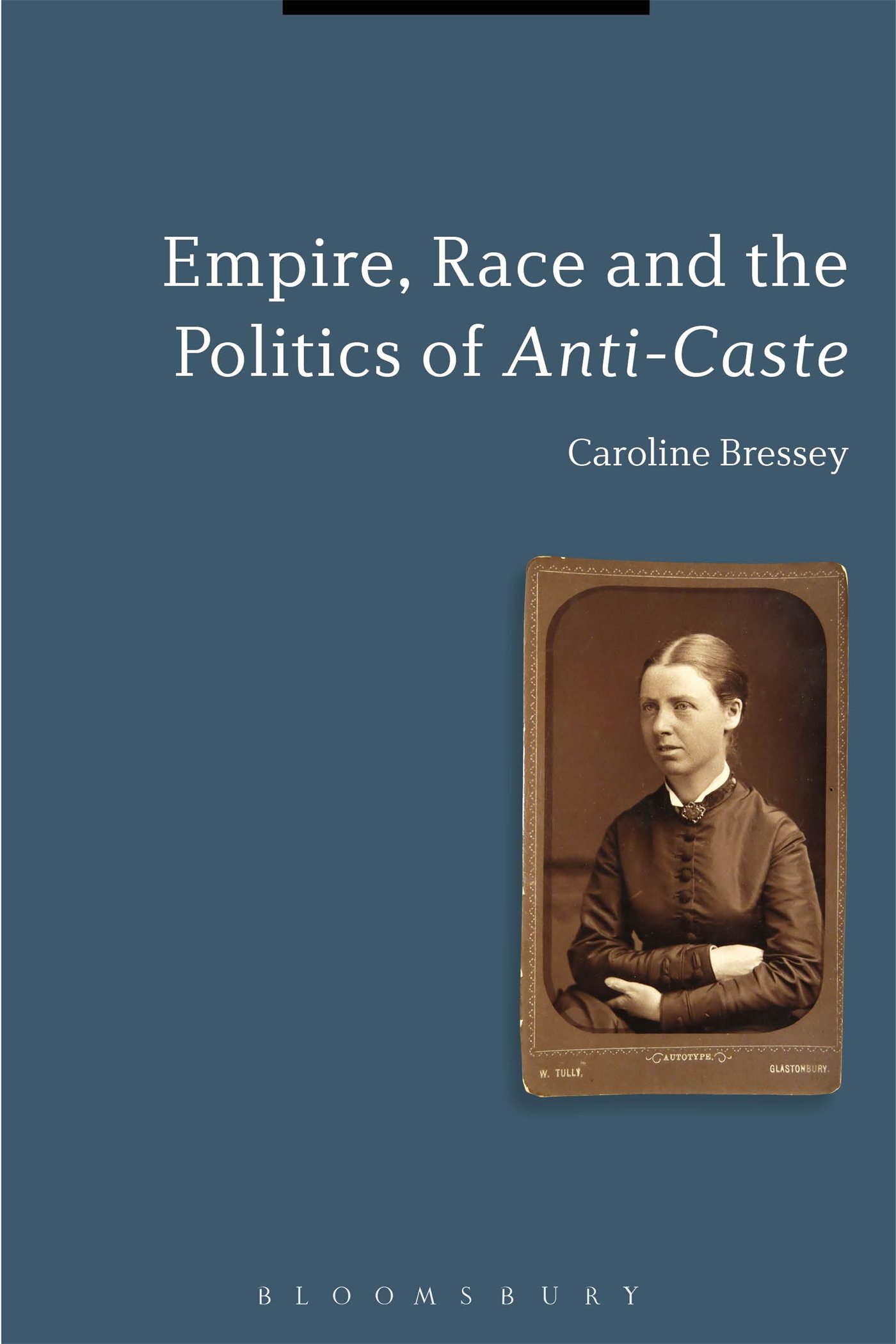
In Caroline Bressey’s book, Empire, Race and the Politics of Anti-Caste, she argued that young working-class women made up part of Edwards audiences and she demonstrated this with the example of the meeting at Fuller’s Hall. (14)
The meeting took place on 14 February 1893 as part of a series of lectures Edwards was giving at the Hall. Eliza had gone to see him. A crowd assembled from 6pm, over an hour before the Charlotte Street doors were due to open. There were so many people that the queue spilled out into the road. Around 1000 people were reported to be crowded against the doorway, so to relieve the pressure, other doors were opened 7.20pm. (15)
Still the crowd continued to increase and so did the pressure which made the lobby floor collapse. Fifty people fell seven feet into the cellar. The Portsmouth Evening News Reported, that,
So closely had the people been standing together that they fell in one solid block and filled the cellar so completely that there was not even room to fall down, and almost all, pitched their feet. (16)
The article continued,
Among the unfortunate people were a number of ladies and their screams easily convinced those who were safe up above, that something wrong had happened. (17)
It was not a severe accident, however. The doors of the hall were opened and a ladder was supplied. Several ‘Gentlemen’ helped the ‘victims’ back up to street level. (18) More of the newspaper report:
Most of the ladies were either fainting or hysterical. They were taken into Mr. Dutton’s Coffee Palace and the lower hall and medical aid were summoned. (19)
The accident was caused by the rotting joists in the floor, which had got damp and given way. The six-year-old building had been renovated three years previously, the cellar sealed up with a mixture of floor boards and concrete. This had led to damp and caused the problem with the joists. Eventually they gave way and the lobby floor collapsed. (20)
Eliza
Nineteen-year-old Eliza was one of the women to fall. She was listed by Caroline Bressey (21) and in the newspaper article, however, she was only slightly injured having sprained her ankle during the accident. Other women were said to be suffering from shock. (22) The Borough Police were called to the scene. Eliza’s Father was a police constable and was also mentioned in Bressey’s book. (23)
It is not clear though, if he attended the scene of the accident.I wonder if Eliza ever got to see Edwards speak? She would not have much more time to do so, for Edwards was suffering from ill health. There was a subscription to raise money, so he could travel back home to the West Indies. (24) He died at his Brother’s home on 24 July, 1894. (25)
It is fascinating what you can find out by looking at your family history. I came across the story while Googling the names of Eliza and her Father and in the context of today and the Black Live Matters protests, it demonstrates the beauty of two historical worlds colliding.
References:
Celestine Edwards in 9thCenturyphotos.com.
Celestine Edwards in Spartacus-educational.com.
Paul Frecker, Celestine Edwards (2020) in 9thCenturyphotos.com
A branch of the non-militant NUWSS (National Union of Women’s Suffrage Societies) was also formed in Peterborough. Miss. P. English of Orton Longueville, was the Secretary. Campaigning was busy. M. H. Renton, had been working in Peterborough, holding two drawing room meetings, one with the dean and another with (now) Mrs. English in Orton Longuville. She also spoke at meetings of several local organisations, in preparation for a much larger meeting. (1)
Millicent Fawcett (2)
On Tuesday 27 February, 1912, this public meeting took place in The Grand Assembly Rooms, featuring Millicent Fawcett and Miss. I. O. Ford. (3) The meeting was chaired by the Dean of Peterborough. The hall was crowded, with many unable to gain admittance. It was reported that there were already 80 members of the NUWSS in Peterborough and there was every hope that the good work in Peterborough would continue. (4)
The Suffrage Pilgrimage
Just as the campaign appeared to be progressing satisfactorily in Peterborough, there was trouble. A strong feeling in Peterborough against Women being granted the vote was demonstrated severely in 1913, during a Women’s Suffragist march between Edinburgh and London. It was reported in many newspapers across the country. The women’s march was led and organised by Florence de Fonblanque, who had been a member of the WSPU from 1907, and from 1912 a member of the New Constitutional Society for Women’s Suffrage. The march had arrived via Stamford and was reportedly met by locals four miles out of Peterborough. While the women entered with banners flying, college students followed them, singing comic songs. (5)
Florence Gertrude de Fonblanque (6)
That evening a meeting was arranged on Stanley Recreation Ground. It was reported to be attended by several thousand people, however, the meeting was broken up ten minutes into the speeches, as the crowd threw fireworks and an ‘ugly’ rush was made for the stage. The Suffragettes were escorted to their hotel (the Bedford) by the police and the crowd followed, apparently remaining outside, singing and booing. One of the women who had been on the four-week march was interviewed when the march reached London. The Dundee Courier reported that the women were exceedingly pleased with the reception accorded to them, on the whole, with ‘…Peterborough being the only one to leave any unpleasant memories.’ (7)
The Peterborough Advertiser asked Mrs. Fordham, the honorary Secretary of the Peterborough branch of the WSPU, what she thought about the matter, at her ‘cheery little home,’ in Fletton Avenue. She said:
I am thoroughly ashamed of Peterborough boys. It was not full grown and sensible citizens who rushed our meeting, threw rotten eggs and endangered life. It was not college boys either, but two to three hundred school boys of about fourteen years of age. And these – these – are the young hopefuls to be given a voice in the government of their imperial motherland… one wonders whether these mad little hooligans, these wise and chivalrous little simians, are so very much fitted when they are grown men, than women, to exercise the responsibility of the vote. (8)
Mrs. Fordham went on to say that she thought the leader of the ‘suffragette pilgrims,’ had not understood what the chief constable meant when he suggested they hire a hall for the meeting, rather than have one in the open air. Mrs. Fordham, questioned why the WSPU were not allowed to hold meetings in the market square, like they did in Cambridge. (9)
However, Mrs. Fordham did vow to re-educate Peterborough people on the issue of votes for women. The WSPU were contemplating holding a series of open-air meetings commencing in New England, moving to the city and onto the Town Bridge. I have found no evidence in my research so far of these meetings taking place. Mrs. Fordham, also specified the non-political party aspect of the WSPU – and reiterated that they were currently opposing Liberal politicians and had opposed Conservatives the same. (10)
Mrs. Fordham was doubtful when asked about the tactics of the Suffragettes with regards to the destruction of private property, but she was ‘loyal to the leadership.’
The last paragraph of the interview with Mrs. Fordham reads as follows:
It is interesting to record that a hat pin which Mrs. Fordham was wearing on Friday night was smashed when a man seized the back of her head and attempted to twist her neck! The pin was in three pieces when home was reached and two of these were pressed into the unfortunate ladies’ head. During the evening too, Mrs. Fordham turned just in time to see a young girl apparently preparing to jab a long hat-pin into her back! It was altogether a rather exciting evening! (11)
So even in Peterborough, it was dangerous to be a campaigner for Women’s suffrage. And opponents of Suffragettes specifically, were worried that they, were equally dangerous. For example, another local paper, The Peterborough Express, were concerned that the city could be a target of the militant Suffragette’s. Worried that the Cathedral could be a target the newspaper quoted a Sentry, as saying, ‘they [the residents of Peterborough] do not want the Suffragettes to come, but their spirit is one that says, by jingo… let me catch them.’ (12)
Fears of militant Suffragette action was perhaps founded after all, with reports in the Peterborough Standard in 1913 of a hoax bomb, found underneath the railway bridge on Oundle Road. It was found with a message saying, Votes for Women. (13) In March of the same year, the Lincolnshire Echo reported that ‘Treacle Parcels’ had been found in a post bag from Peterborough that was opened in Horncastle. The act was believed to be the work of Suffragettes using a tactic of sending a jar of treacle through the post, but leaving the jar unsealed so the contents slowly leaked out all over the rest of the mail. Boston Parcels were also reported to be ‘treacled’ too. (14)
Conclusion
The campaigners for Women’s Suffrage in Peterborough, were popular with some of the city’s population but not with others. There were many women involved in the Women’s Suffrage movement in Peterborough, in two phases: the late 1800s and the early 1910s.
Some of the Women involved were passing through and already had some notoriety as militant Suffragettes, such as Helen Craggs and some who took an interest locally came from well-established city families, like Lily Gill. Campaigners were women who had the time and means to get involved, such as Mrs.Fordham and the votes for women campaign was also well supported by both philanthropists like Louise Crieghton (eventually) and champions of the working class as seen in Benjamin Taylor. Some supporters were also male.
We all know that the vote was finally given to women in February 1918, although it was only to women over 30 with certain property qualifications. For all other women aged 21 and over, the vote was grated in 1928. I shall look forward to the commemorations on that day.
Votes for Women campaigners in London. (15)
References
Elizabeth Crawford, The Women’s Suffrage Movement in Britain and Ireland: A Regional Survey, by Elizabeth Crawford, p. 73.
Photo, Millicent Fawcett, Wikipedia online.
Peterborough Advertiser, Saturday 24 Feb, 1912, p. 1.
Reference misplaced.
Peterborough Advertiser, Saturday 16 November 1912, p. 5.
Photo, Florence Gertrude de Fonblanque, Wikipedia online.
Peterborough Advertiser, Saturday 16 November 1912, p. 5.
Peterborough Advertiser, Saturday 16 November 1912, p. 5.
Peterborough Advertiser, Saturday 16 November 1912, p. 5.
Peterborough Advertiser, Saturday 16 November 1912, p. 5.
Peterborough Advertiser, Saturday 16 November 1912, p. 5.
Peterborough Advertiser – Saturday 16 November 1912, p. 5.
Peterborough Advertiser, Saturday 16 November 1912, p. 5.
On Thursday 27 May, 1910 at the Grand Assembly Rooms on Wentworth Street, the first WSPU (est. 1903), meeting took place in Peterborough. Tickets for this meeting were obtained from Casters book shop. The Chair was Dr, Glaisher, from Trinity College in Cambridge. He was supported by Mrs. Rackham, Miss Ward and Miss Corbett. The meeting examined the objectives of the society as a constitutional, non-militant and non-party political campaigning body.
The WSPU, it was stated, were appealing to people’s sense of justice with regards to votes for women. The National Union had gone from 50 – 130 branches in 3 years and it was hoped that a Suffrage Society would appear in Peterborough soon. The local paper said her appeal was “not overwhelmingly successful.” (2)
Debates at the Liberal Club.
In October 1910, the Liberal Club, led by Peterborough Women’s Liberal Association, hosted a debate on Women’s Suffrage. Speaking on behalf of the Suffragette movement, according to the Stamford Mercury, was Suffragette, Miss McArthur. Unfortunately, it is difficult to trace women when only surnames are mentioned. However, the only McArthur I can find in a list of Suffragettes, is Mary McArthur, who was involved in the Trade Union Women’s League and led the 1910 Cradley Heath Chain-makers in a strike in the West Midlands, that is still commemorated today. It would be great to hear that she passed through the city.
Speaking against Miss McArthur, was Mr. H. F. Oldham from Cambridge. People who spoke in the debate, includes Mr. W. E. Cross, the Head Master of the Kings School and Liberal MP and former town councillor, Richard Winfrey, MP and his wife Elizabeth. At a vote taken at the end of the meeting, the ‘for’ votes for women side, lost by a mere five votes. (3)Interestingly, a debate at the Conservative Club in January 1912, resulted in a 2:1 vote for women’s suffrage. (4)
Between 1910 and 1911, a Bill advocating votes for women was passed in Parliament. However, the Bill did not become Law. Some MPs were against certain women getting the vote, e.g. the 1 million rich women, who would vote Conservative. The Liberal MPs were not keen on that idea. So, the campaigns continued. In December of 1910, a General Election bought a Liberal Government into power.
Early WSPU activity in Peterborough.
In 1911, Helen Craggs became the first WSPU organiser for Peterborough, working from number 14 Cromwell Road as Secretary. She was answerable to Grace Roe, at Ipswich. Craggs, originally from Oxford, was one of the Militant Suffragettes that was arrested at riots in London in 1910, (5) and she had joined the WSPU in 1908, under the name Helen Millar and chalked pavements and handed out literature in Peckham, London.
Craggs was close to Emeline Pankhurst’s son, Harry, who suffered from polio and died in January 1910 and in November of the same year, she hid in the roof space of the Paragon Theatre Whitechapel, where Lloyd George was due to speak, then burst out shouting about votes for women. She was thrown down a stone staircase and a man who stuck up for her was beaten. (6) Craggs did not stay for long organising in Peterborough, Mrs. Fordham became honorary Secretary in 1912.Then, in the Peterborough Advertiser, Sat 11 February 1911 edition, there was an article advertising meeting held by the WSPU. An anonymous lady correspondent wrote:
To the average man and woman, the lull in political activity following the General Election, is welcomed as a merciful release and relief from exhausting exertions, once more to the conditions of normal existence. One organisation there is, however, which never slumbers of sleep, and whose members seem inspired with the principle of ceaseless activity; we refer to, of course, to those ubiquitous band known as the Women’s Political and Social Union, or better still, as the Militant Suffragettes. (7)
These, we have always with us now, in this country, and if it is true that, “it’s dogged that it does,” then we must admit that these indefatigable ladies, are bound soon to come into their own. The Suffragettes who were active in the last elections have now settled in Peterborough and are preparing to persue their campaign in this locality with relentless vigour. (8)
We, see that preparations have been made to hold a meeting on February 14 at the Corn Exchange, which will be addressed by Miss [Katherine] Douglas Smith, one of their cleverest speakers, and on February 22nd, Peterborough itself is to have a visit from Pankhurst who will speak in the afternoon in the Fitzwilliam Room of the Angel Hotel and in the evening at the Corn Exchange. (9)
With regards to Emeline Pankhurst, leader of the WSPU / Suffragettes, the correspondence continued:
Opinions may be bitterly opposed as to both the principle and methods of Women’s Suffrage, but no-one who has ever heard Mrs Pankhurst seems to differ as to the exceptional charm of her personality as a public speaker. Mrs Pankhurst has lately been in Paris where she had a remarkable reception amongst leading French, American and English Women, her visit there ending with a highly successful meeting. She was also interviewed by the Figaro who gave her a most appreciative notice. She is evidently – however much we may disagree with her – one of the most remarkable of our present-day celebrities, and we have no doubt that residents both in Peterborough and the adjoining districts, will take the opportunity afforded them of her visits here, to judge for themselves as to what she is and as to the merits of the cause she will lead before them. (10)
This was not the first time that Pankhurst spoken in the city. She came to speak at the first meeting of the Peterborough branch of the Independent Labour Party in 1905.
The visit of Emmeline Pankhurst
However, following Emeline’s first truly public meeting in Peterborough, The Peterborough Advertiser, ran an article. The headline read:VOTES FOR WOMEN! THE SUFFRAGETTE CAMPAIGN AT PETERBOROUGH, VISIT OF MRS PANKHURST (11)When she came to Peterborough on 22nd February, Pankhurst, hosted an ‘at home.’ In the Fitzwilliam Assembly Rooms at the Angel Hotel. Mrs Mansel presided over the meeting which was attended by:Katherine Clayton and her daughter Kitty, the Beeby’s who were part of brick company of the same name, Miss Hall, principal of the Girls’ High School, Nurse Wilde; Mrs. Pfleiderer of the firm that what would soon become Baker Perkins and others were in attendance. (12)
In her opening remarks, Mrs. Mansel, said that agitation for Women’s Suffrage, had lasted for forty years some; and forty Bills had be introduced to Parliament and no fewer than six had passed the second reading. They had the very greatest possible hope this year was going to see a very different issue (applause). It appeared the stars, in their course, were on their side. Irishman, Liberal, and Conservative had drawn the first places in the ballot, and Sir Kemp, the Liberal Member for South-Manchester, was to introduce a Women’s Suffrage Bill, and the second reading was set down for May (hear, hear). (13)
Pankuhrst, introduced to her audience as “Our leader,” said from an experience of public meetings extending over a period approaching forty years, she found they might convert people to the cause, generation after generation, and then they would have to begin again with the next. The WSPU could convert them. “Go with your patient work converting,” she told her audience.
Pankhurst was tempted to say it was very much like that famous stone of Sisyphus, which when rolled up to the top of the hill, came down, and they had to start rolling it again. The whole difference, Pankhurst continued, between the militant agitation and the so-called constitutional suffragist, was that the constitutional suffragist thought the work of conversion was efficient. And when every-body was converted, Women’s Suffrage would drop right down their laps (laughter). Militant Suffragettes whilst recognising the conversion, said the case was now urgent – that the time for discussion and argument had come to end, and the time for action had arrived. suffragists would wait little longer, but with the suffragettes, waiting had become crime and impatience a virtue (applause). (14)
One of the effects of militant agitation was that people were coming to their meetings who had never come before. In the early days of the suffrage movement, Emeline was content to be patient, and it was within the last four years she had turned into one of those ‘hysterical persons’, who threw stones and went prison (laughter). The Suffragette recognised that some people might have come to that meeting to see what a militant suffragette was like, and she had heard of people coming to their meetings with half reservations and half a terrible feeling of excitement that something terrible might happen whilst they were there (laughter). (16)
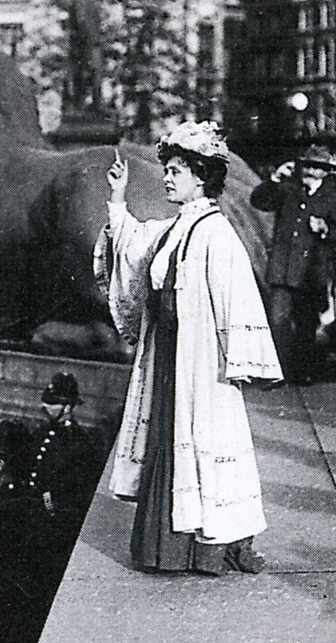
Emmeline Pankhurst, addressing a crowd in Trafalgar Square, London. (17)
Emeline said that the case of votes for women, was as if the Government had read “Alice in Wonderland:” it was ‘jam yesterday, jam to-morrow, but never to-day.” Men asked, why did Women want the vote? They did not want to act or look like men, nor be less womanly than before. They wanted bring into politics the women’s side, the women’s point of view (applause).
If women were given sufficient power and control themselves, they would able to develop a standard of woman very much higher and nobler than they had known now (applause). Pankhurst said her husband, years ago, had said, “You will never get [the vote] unless you create an impossible situation.” and she thought the census would provide that (applause) – and Suffragettes did indeed, refuse to take part in the 1911 census. Well some of them. Emily Davidson, who was to die two years later at the Derby, hid in the House of Commons so she could be included on the 1911 census by being there (she was not successful though). (17)
In conclusion, Pankhurst said she hoped the time was not far distant, when women would be in the position, for their urgent duty in making, with men, a better and purer world for all those who came afterwards, than ever men would be able make the world themselves (applause). (18)
Tea was served after this meeting. The ladies assisting were Helen Craggs and Miss Rowe, who in 1914 would be the local Branch Secretary of the National Federation of Women Workers. The organisers were, Mrs. Fordham, Miss Tebutt (described as local members of the movement). Miss King and Miss Fison (from Ipswich), Miss F. Ward and Mrs. J. B. Levitt (March) Miss Vergette, Miss Lily Gill, the daughter of the Council’s Chief Engineer according to the 1912 census and twenty-six-year-old Jessie Wadlow, who lived in Dogsthorpe with her wealthy family. The floral decorations on platform were lent by Councillor Vergette. (19)
The evening meeting, was reported on by The Peterborough Advertiser, who set the scene perfectly:
The Corn Exchange was crowded for the evening meeting. The audience including many of the leading ladies and gentlemen of the city. The hall was profusely and artistically decorated with purple and green, and banners were suspended at intervals, bearing the mottoes of militant suffragettes. The spirit of determination which characterises the campaign of this organisation was demonstrated in such declarations as,
Through thick and thin, we ne’er give in
We fight to win
Keep on pestering
Arise, go forth and conquer. (20)
It was, according to the report, an orderly evening, except one man who kept interrupting the speaker. But in her speech, as well as repeating parts of what she had said in the ‘at home,’ meeting earlier in the day, Emeline Pankhurst also spoke of the poor and working classes and what the vote would mean for them. (21)
It was time politics ceased to be a game (applause). They must bring into politics the women’s point of view. They were told there were to be a break-up of the Poor Law. She had no confidence in a re-adjustment of the Poor System, until the women’s point of view was to be heard – the view that considered human life, not institutions. Men had made such a terrible muddle of things, votes for women were the only way out… In such a civilised country …there were more people living in degrading conditions than otherwise, surely it was high time the women of England, stepped in and had their say when men made such a mess of it… she preceded to say that old age pensions were not introduced until the militant movement of Suffragettes had started. (22)
It was reported she said that to much amusement from the audience.
Pankhurst was well received though. At the end of the meeting, a vote was taken and it was almost unanimous that the room supported the latest Conciliation Bill towards Women’s Suffrage. (23)
Annie Kenney.
This meeting was followed up in February 1912, when WSPU Executive Committee member, Annie Kenney spoke at the Church Institute in Peterborough. Organised by Miss Millar of Northampton District WSPU and Mrs Fordham. Kenney spoke about how she had been to prison four times, how women with votes would be easier to handle than those without and she spoke of her fondness for Christabel Pankhurst. In the newspaper reporting the event, a cartoon was reproduced from Punch magazine which showed a suffragette speaking to mother on the doorstep, entitled, ‘No Lady.’ (24)
Kenney was sent to prison 13 times in all. She joined the WSPU in 1905 after seeing Christabel speak in Oldham and the two women confronted Winston in October that year at the Manchester Free Trade Hall.
Emeline Pethick.
On 30 April 1912, Emeline Pethick also spoke at a meeting held at the Church Institute in Peterborough. She spoke on the subject of, ‘the present position.’ The meeting was chaired by Miller. Pethick, said that some people in Peterborough were sympathetic to the vote, although the headline in the newspaper reporting the meeting read ‘no enthusiasm in men’s votes for outraged women.’ But a bone of contention with Pethick, was whether they had gone too far with militant suffragettes and saw no need for prison hunger strikes. Although she defended their actions, Emeline did not really believe in militancy as a tactic and was ousted from the WSPU later that year. (26)
This blog article has been through the visits of some of the high profile WSPU activists to Peterborough at the height of the votes for women campaign. In part three, find out who nearly got stabbed with a hatpin when the Suffragette pilgrimage reached Peterborough.
Part 1: Women’s Suffrage Campaigners in Victorian Peterborough.
I have written a few blog articles and given a few talks about Peterborough’s Suffragettes. Each time I do some more research, new information comes to light adding to the depth of the character’s involved. It has taken me several years to get this far.
Katherine Hare.
The story starts with Katherine Hare, born in 1843, Leicester. Her Father, Thomas Hare, a political reformer and Chancery barrister was the author of policies which had the backing of economists Henry Fawcett and Stuart Mills. Brought up in a family of reformers, both Katherine and her Sister, Alice signed the 1866 petition of women’s Suffrage. (1)
In 1864 Katherine became interested in Emily Davis’ movement to extend the Local Examination system to girls and joined as a member of the Kensington Society, a London discussion group for women which became the place where rising Suffragettes would meet. From 1867, she was an executive committee member of the London National Society for Women’s Suffrage. (2)
Katherine married Lewis Clayton in 1872 and he became the Bishop of Leicester and the assistant Bishop, resident canon of Peterborough. In the book, The Women’s Suffrage Movement: A Reference Guide 1866 – 1928, Elizabeth Crawford said that:
She [Katherine] disappears for some time from the Suffrage movement.(3)
This may be true on the national scene however, she took an active part in the campaign for women’s suffrage and for other reform when she lived in Peterborough, however, she had four children and the responsibilities of a clergyman’s wife to deal with.
Benjamin Taylor
Benjamin Taylor, Peterborough’s forgotten working class hero, worked himself up from a rural Lincolnshire life to become a Town Councillor and Bailiff of the Country Court. He also established local branches of the Cooperative Society and the Agricultural Labourers Union in and around the town and was an ally in the campaign for women’s suffrage.
The first calls for Women’s Suffrage in Northamptonshire came from Peterborough via a petition on the 15th Aril, 1869. A further petition was submitted in June of the same year. More followed in 1870 and 1871. In March 1872, another petition was signed, this time at a meeting on Women’s Suffrage, Chaired by Taylor. (4)
Taylor, chaired another meeting regarding women and the vote in 1873, where Caroline Biggs, a Leicester born Executive Member of the National Society of Women’s Suffrage and Emily Spender, feminist novelist from Bath, spoke, as part of a Suffrage tour.
The next meeting on the subject of Women’s Suffrage in Peterborough, was Chaired by the Reverend Alexander Murray, Minister of the Congregational Chapel on Westgate and took place in December 1874. Helena Downing, an Irish Socialist spoke at this meeting. The Minister was so moved by the speeches that following the meeting, he subscribed to the Central Committee of the National Society for Women’s Suffrage. He remained a member for several years.
Helena also spoke at the next meeting of Suffrage, (under her married name of Shearer). This meeting did not take place until almost a decade later, in 1882, where she spoke alongside Maye Dilke, author of the book, Women’s Suffrage: A Treatise on Equality. The two speakers claimed to have been a deputation sent by the Central Committee. The Mayor of Peterborough, John Thompson, chaired this meeting. Councillor Benjamin Taylor was in attendance. (5)
Louise Creighton, Nee Von Glehn (1850 – 1936)
Around the Peterborough scene in the 1890s, was Louise Creighton. She came from a Conservative Middle-Class family in Sydenham, just outside London, Louise married Mandell Creighton, and lived in Oxford, Worcester and Cambridge. In 1891, Mandell was made ‘see of Peterborough’ and the new Creighton family were forced to spend some time living in the city. A Victorian social reformer, influential in the Church, Louise helped to set up the non-party political, National Union of Working Women (NUWW), in the 1880s, now known as the National Council for Women. Louise was not a campaigner for Women’s Suffrage through. In fact, the opposite: she helped collect names for an anti-suffrage petition in 1889, against votes for women, believing that there needed to be intellectual and influential people outside of party politics. (6) She wrote essays on the subject, writing that,
It is merely a part of the machinery of Government…we are very tired of the rich and cultivated lady who may not vote while her coachman may. If the vote was privilege of the wise and the educated, women may simply claim it. But it is part of the propelling power of a part of the machinery of Government which has always belonged to one sex. (7)
In Peterborough, Louise founded the local branch of the Mother’s Union, of which Katherine Clayton was Secretary. Louise became the President of the NUWW in 1895. And then in 1901, her Husband, Bishop Creighton died, prompting Louise to announced at the NUWW Conference in 1906 at Tonbridge Wells, that she had changed her mind regarding the subject of votes for women. She was worried that, people would think that this change of heart would be connected to her Husband’s death. This was not the case. Louise’s reason for deciding she was for votes for women after all, was that, she had now seen women becoming involved in party politics and thought, they should get the vote to help them in their cause. This caused friction within some factions of the NUWW because of the question of affiliation of suffrage campaigners. However, Louise went on to be influential in the votes for women campaign. (8)
By 1909, the campaign for Women’s Suffrage was no closer to achieving its goal than it was in the 1860s. However, by 1908, most MPs supported votes for Women and the campaign was hotting up. The story continues in part 2.
Kensington Society rules (9)Louise Creighton (10)
References
Elizabeth Crawford, The Women’s Suffrage Movement: A Reference Guide 1866 – 1928 (Routledge, London: 2003) p. 275.
Elizabeth Crawford, The Women’s Suffrage Movement: A Reference Guide 1866 – 1928 (Routledge, London: 2003) p. 275.
Elizabeth Crawford, The Women’s Suffrage Movement: A Reference Guide 1866 – 1928 (Routledge, London: 2003) p. 275.
Elizabeth Crawford, The Women’s Suffrage Movement in Britain and Ireland: A Regional Survey, by Elizabeth Crawford, p. 73.
Elizabeth Crawford, The Women’s Suffrage Movement in Britain and Ireland: A Regional Survey, by Elizabeth Crawford, p. 73.
There has been a recent debate in my local newspaper, The Peterborough Telegraph about ‘famous Peterborians.’ The debate has been around the inclusion of women, or more specifically, the fact that there has only been two women out of a list of twenty people. Women’s history is something I feel very passionate about and since I have been researching local history, I have made a concerted effort to include women’s history.
Gladys Benstead
One of the women I have written about previously was a working class woman, Gladys Benstead. I wrote about her for another blog site which is linked in a previous post. She is one of the women that I would include on my list, the first woman to work as a railway clerk, outside of London and a negotiator for women’s wages in the National Union of Railwaymen in the 1920s. It was very unusual for a woman to hold such a position in the trade union movement at that time and I think that is important. Important people don’t have to be so because they give grand gestures to the general public because of their wealth . They can be important through helping to inch forward matters such as women’s rights.
Katherine Clayton (Nee Hare), 1843 – 1933
My second candidate is a little different, in Katherine Clayton. Instead of writing a blog simply about her, I am going to reproduce parts of a talk that I did for Peterborough’s local archive service on the campaign for Women’s suffrage in Peterborough, which contains much of Katherine’s history and it also contains a little about Louise Creighton.
Katherine was born in Leicester. Her father was Thomas Hare, born in 1603 a Liberal reformer, a Barrister by trade. He held the position of ‘Inspector of charities’ and set out a proposal to use proportional representation to elect MPs to Parliament in 1859. This was a policy backed by economist John Stuart Mill and Henry Fawcett. Later, he became involved in the call for women’s suffrage, speaking at public meetings and joining campaign groups. It was no wonder that with the influence of her father, Katherine herself, became involved in the campaign for women’s suffrage, joining the debating group, the Kensington Society who often discussed the matter and she signed petitions destined to Parliament in, starting in 1866.
In 1872, Katherine married Lewis Clayton, who would become the Bishop of Peterborough and the couple moved to Peterborough, where they bought up four children. Katherine continued her involvement in the campaign for votes for women through this time, signing a memorandum to sir Arthur Balfour in 1896, asking the Government to give time over to discussing the matter in Parliament. She also attended local meetings for women’s suffrage with her daughter, Kitty and also attended an ‘at home’ meeting with Emmeline Pankhurst at the Fitzwilliam Rooms of the Angel Hotel on 11 February, 1911.
Katherine was also involved in campaigns around education and she was awarded an OBE for this. She was also made a ‘freeman’ of Peterborough for her services in social work. Another of Katherine’s local campaigns was raising money to replace the marble tomb of Katherine of Aragon at Peterborough Cathedral. Apparently, a former Bishop had broken up the former memorial to use for his conservatory. Katherine campaigned by contracting other wealthy ladies with the same name and asking them to donate. The results are the beautiful tomb which you can see today.
Louise Creighton 1850 – 1936
Louise was the wife of Mandell Creighton, the Bishop of Peterborough. To be honest, she only spent a short time in Peterborough between 1891 and 1897 and moved between there, Cambridge and Oxford, however, she was a massive influence on Katherine Clayton. A Victorian social reformer, Louise was influential in the Church and she set up the National Union of Working Women in 1881, which was later known as the National Council of Women. She became President in 1895, and Katherine Clayton was listed as having sat on the committee of the local branch in 1922. Louise also set up a Peterborough Branch of the Mother’s Union of which Katherine was Secretary.
Louise did not share Katherine’s view of women’s suffrage however, she spent her time rebuking calls for votes for women, at least until her Husband died in 1901. She declared her change of opinion at a National Council of Women conference in 1906, having not done so before for worry that it would look like she had not been able to have these opinions while her Husband was alive. However, she had changed her mind because she saw women becoming involved in politics and starting to make a difference. Louise went on to be influential in the Votes for Women campaign.
Although Louise Creighton spent little time in Peterborough, I believe she is an important figure to acknowledge in the Women’s history of the city. Katherine certainly deserves her place on the list for services to women and children. She must certainly have impressed someone to become a ‘Freeman’ and to be awarded an OBE.
Summary
There must be thousands of women that we know nothing about, but who we should. Sometimes they have been written out of history because they were illiterate and could not write down their own achievements , or they were ignored by historians or their contemporaries, it does not mean they did not exist. I have made it my mission to change attitudes but unfortunately I was not able to find photographs of Gladys or Katherine, but have included one of Louise and I hope you have enjoyed reading about this article. If you want to know more about Peterborough’s women, please take a look at the references below. These contain details of other blog sites which you can look at, some of which contains some more candidates for important women from Peterborough.
References:
The Peterborough Advertiser, Saturday, 22 February, 1911, p. 2; The Women’s Suffrage Movement in Britain and Ireland: A Regional Survey, Elizabeth Crawford, p. 73 The Women’s Suffrage Movement: A Reference Guide, 1886 – 1928, Elizabeth Crawford; The Oxford Dictionary of National Biography (Online); Historical Directory for Peterborough. 1922; WomenWhoShapedPBoro.wordpress.com/category/Katherine-Clayton; akennedysmith.com/2017/06/16/light-and-shade-louise-Creighton-1850-1936/






 History Haze: Independent History Researcher